GOUT: DIAGNOSIS AND THREATMENT
16 January 2026, Friday
What is Gout
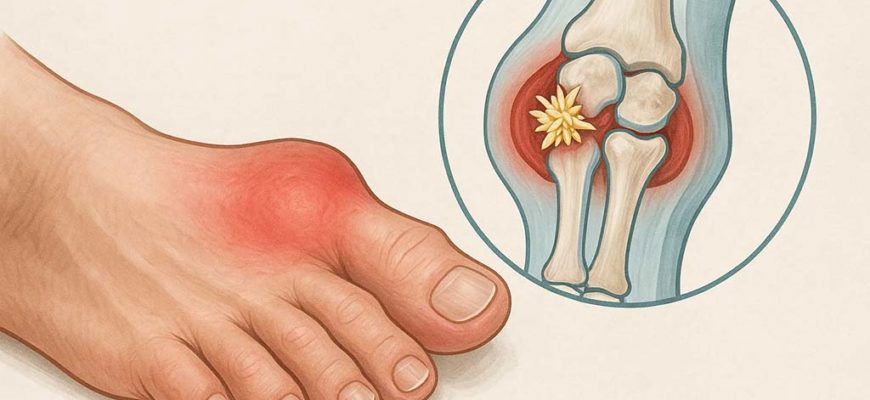
Gout is a chronic metabolic disorder characterized by elevated uric acid levels in the body. As a result, monosodium urate crystals deposit in the joints and tissues, causing inflammation, severe pain, and eventually joint deformity.
Causes and risk factors
The main cause is hyperuricemia (persistent elevation of uric acid in the blood), which may be due to:
impaired purine metabolism,
decreased renal excretion of uric acid,
excessive dietary intake of purines.
Risk factors:
male sex, age over 40,
alcohol consumption (especially beer and spirits),
high intake of meat and seafood,
obesity, metabolic syndrome, arterial hypertension,
chronic kidney disease,
genetic predisposition.
Types and classification
Acute gout – sudden attacks of severe pain, usually at night, often involving a single joint (commonly the first metatarsophalangeal joint).
Chronic gout – recurrent attacks, tophi formation, joint deformities.
Atypical forms – polyarticular, subacute, asymptomatic hyperuricemia.
Main symptoms
sudden, intense joint pain (often at night),
swelling, redness, increased local temperature,
restricted mobility,
in chronic cases – tophi (deposits around joints, ear auricles),
recurrent attacks with progressive involvement of new joints.
Diagnosis
Clinical: typical gout attacks, presence of tophi,
Laboratory: hyperuricemia, elevated inflammatory markers,
Synovial fluid analysis: detection of monosodium urate crystals (gold standard),
Imaging: X-ray (erosions, punched-out lesions), ultrasound (“double contour” sign), CT if necessary.
VIDEO
Modern treatment methods
During acute attack:
NSAIDs (ibuprofen, naproxen, indomethacin),
colchicine,
short course of glucocorticoids in severe cases.
Intercritical (long-term therapy):
allopurinol or febuxostat to lower uric acid levels,
uricosuric agents (benzbromarone, probenecid) in patients with preserved renal function,
lifestyle modification: weight reduction, alcohol abstinence, purine-restricted diet.
Possible complications and prevention
Complications: chronic gouty arthritis, joint deformities, tophi, chronic kidney disease, urate nephropathy, urolithiasis.
Prevention:
regular monitoring of uric acid levels,
dietary restriction of purines,
avoidance of alcohol,
adequate hydration,
timely treatment of hyperuricemia.
When to see a doctor
at the first episode of acute joint pain,
if attacks occur more than 1–2 times per year,
when tophi or joint deformities appear,
in case of kidney disease or hypertension,
if standard painkillers are ineffective.
Shushanna Aristakesyan, Rheumatologist
Shushana Aristakesyan, December 28, 1988
Education
Yerevan State Medical University: 2005-2013
Rheumatologist, Yerevan State Medical University, 2011-2013
Professional activity
Associate Professor of the Faculty of Medicine, 10.28.2013 - 01.01.2019
Rheumatologist and ENT at the Central Military Hospital/Stepanakert, 04.26.2018 - 10.15.2019
Lecturer in Rheumatology at Yerevan State Medical University, 2019 - present
Lecturer in rheumatology at the Institute of Surgery. Mikaelyan, 2019 - present
Сpecialist of the 1st Polyclinic, 02,2019 - present
In 2022, a rheumatologist at MC VitaМed
Armenian Association of Rheumatologists
Trainings
Mkhitar Heratsi State Medical University, 2005-2011
Endocrinology, France, 01.08.2008 – 08.31.2008
School of Rheumatology, University of Rheumatology, Russia, 04.06.2012 – 04.09.2012
Salzburg Seminar on Internal Medicine, 06.30.2013 – 07.06. 2013
Summer School of Rheumatology, Germany, 07.13.2014 – 27.07.2014
Ultrasound specialization, 2015 – 04.2016
Connections, 04.11.2019 - 02.12.2019
Register



 279
279


